


Introduction
Boys bedroom paint ideas are having a real moment right now — saves for this exact trend are up 500% on Pinterest in the last month alone. The days of the safe, single-color boy’s room are fading fast, replaced by checkered patterns, bold accent walls, and palettes with real personality.
Honestly, I noticed this shift before I even looked at the numbers. Every time I scroll through home decor inspiration lately, it’s the bold, playful boys’ rooms that stop me mid-scroll not the plain blue-wall setups I grew up seeing in every friend’s house. There’s something about a room that clearly reflects a kid’s actual personality, instead of a generic “boy” template, that just feels more thoughtful.
Part of what’s driving this is simple fatigue with the default options. For years, the go-to formula for a boy’s room was a single flat blue or grey wall and a themed bedding set tied to whatever show or character was popular that year. That formula works, but it dates quickly, and it doesn’t leave much room for a kid’s actual personality to show through the walls themselves.
I haven’t painted a kid’s room myself, so I won’t pretend to have a favorite brand or a personal before-and-after story here. What I can do is break down the pattern across the rooms actually driving this spike, and be honest about what looks like a passing trend versus what’s likely to hold up.
Here are 15 boys bedroom paint ideas worth considering, from full commitment to low-risk accents.
Quick Reference: Boys’ Bedroom Paint Ideas by Commitment Level
| Idea | Effort Level | Best For | Easy to Change Later? |
|---|---|---|---|
| Checkered Accent Wall | Medium | Toddler to teen | Moderate — needs repainting |
| Two-Tone Horizontal Split | Medium | Any age | Moderate |
| Deep Navy With White Trim | High (full room) | Older kids/teens | Harder — needs primer |
| Sports-Court Stripe Wall | Low | School-age kids | Easy |
| Ceiling as the Accent | Low | Any age | Easy |
| Single Statement Wall | Low | Any age | Very easy |
| Muted Primary Colors | Medium | Younger kids aging up | Moderate |
| Growth Zone Marking | Low | All ages, sentimental | Very easy |
| Rust or Burnt Orange | Medium | Older kids/teens | Moderate |
| Charcoal Grey Base | High (full room) | Teens | Harder — needs primer |
Use this table to quickly narrow down which ideas fit your budget, effort level, and how often your child’s taste tends to change.
1. Checkered Accent Wall
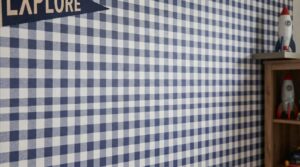
This is the pattern driving most of the current spike in boys bedroom paint ideas. A checkerboard pattern on one wall — painted in two contrasting or two close-in-tone colors — reads as playful without needing cartoon characters or a specific “theme.” It also works at almost any age, from toddler to teenager, if the colors are chosen carefully.
2. Two-Tone Horizontal Split
Paint the lower half of the wall one color and the upper half another, divided by a straight line or a thin strip of trim. This is a classic technique that’s showing up again in current boys’ rooms because it adds visual interest without the full commitment of an all-over bold color.
3. Deep Navy With White Trim
Navy is one of the few “bold” colors that reads as timeless rather than trendy. Paired with crisp white trim and ceiling, it gives a room depth and a slightly more grown-up feel than brighter primary colors.
4. Sports-Court Stripe Wall
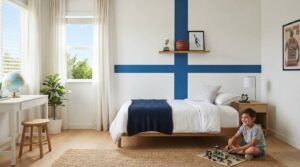
A wide painted stripe — inspired by a basketball court line or a racing stripe — across one wall is a lower-effort way to add graphic interest. It reads as intentional rather than random, and it’s easier to redo later than a full checkerboard pattern if tastes change.
5. Ceiling as the Accent
Instead of an accent wall, paint the ceiling a bold or unexpected color and keep the walls neutral. This is a less common approach, which is part of why it stands out, and it’s easy to change later since ceilings are usually a smaller surface area than a full wall.
6. Color-Blocked Lower Half
Similar to the horizontal split, but using painter’s tape to create a more architectural, angled line rather than a straight horizontal one. It’s a slightly more advanced DIY project, but it photographs well and adds a custom, designed feel.
7. Forest Green for an Outdoorsy Feel

Green has been showing up consistently in current boys bedroom paint ideas, particularly deeper forest or hunter greens. It pairs naturally with wood furniture and reads as calming rather than overstimulating, which some parents prefer over brighter primary colors.
8. Single Statement Wall Behind the Bed
Rather than a full room commitment, paint just the wall behind the headboard. This keeps the rest of the room neutral and easy to update as the child’s taste changes, while still giving the room a clear focal point.
9. Muted Primary Colors, Not Bright Ones
A dusty blue instead of a bright primary blue, or a muted red instead of fire-engine red, gives a room a similar playful energy without looking like it belongs to a much younger child. If you like the idea of a bolder look but want more direction, these bold bedroom ideas that break the usual rules cover the same balance for adult spaces. This is one of the easier ways to future-proof the room as the child gets older.
10. Paint a “Growth Zone” for Height Marks
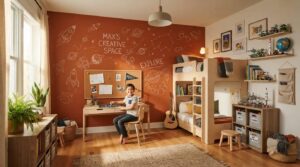
A small painted section — often a contrasting color or a simple painted ruler design — specifically for marking height over the years. It’s a small, sentimental detail that doesn’t require repainting the whole room and adds a personal touch that generic decor can’t.
11. Checkerboard Ceiling Instead of Wall
For a bolder take on the checkered trend, some rooms are moving the pattern to the ceiling instead of a wall. It’s a higher-effort project, but it’s also a detail visitors don’t expect, which makes the room feel more custom-designed.
12. Rust or Burnt Orange for Warmth
Rust and burnt orange tones are appearing as an alternative to the more expected blues and greens in boys’ rooms. They pair well with wood tones and warm lighting, and they read as current without tying the room to a specific age group.
13. Match Paint to a Hobby, Not a Cartoon
Instead of painting walls to match a specific character or show — which a child will likely outgrow within a year or two — choosing a color connected to a broader interest (space, sports, nature) tends to hold up longer without needing a repaint.
14. Charcoal Grey as a Base Neutral
For families who want to add bold accents (posters, bedding, rugs) without committing to a bold wall color, charcoal grey is a popular base that reads as more mature than standard light grey, while still being easy to build around — similar to how dark academia bedrooms use charcoal and moody tones as a neutral backdrop.
15. Test the Color Before Committing the Whole Room
This applies to every idea on this list. Paint colors shift noticeably depending on the room’s lighting and the time of day. A sample swatch on the actual wall, viewed morning and evening, prevents a full repaint if the color looks different than expected once it’s up. Benjamin Moore’s covers why lighting changes how a color reads, if you want to understand the science before testing swatches.
Frequently Asked Questions
What age is this checkered pattern trend appropriate for?
It works across a wide age range, from toddler rooms through teenage years, mainly because it doesn’t rely on a specific character or theme that a child will outgrow. Color choice matters more than the pattern itself for making it feel age-appropriate.
Is this trend likely to still look good in a few years?
I can’t guarantee that with any trend — colors and patterns do shift in popularity over time. Choosing an accent wall or a smaller painted zone, rather than committing the whole room, makes it much easier to update later if needed.
What’s the lowest-cost way to try one of these ideas?
A single accent wall behind the bed, or a small painted “growth zone,” are both low-cost ways to test a bolder look without repainting the entire room.
Do I need to prime over a dark color before repainting later?
Usually yes, especially over navy, charcoal, or deep green. A tinted primer designed for covering dark colors will save you from needing multiple coats of the new color later.
Should the whole room match one color scheme?
Not necessarily. Many of the rooms driving this trend use one bold wall or ceiling as the statement, with the rest of the room kept in simpler, neutral tones — this makes the bold choice feel intentional rather than overwhelming.
Are bright primary colors out of style now?
Not exactly “out,” but muted versions of primary colors are appearing more often in current boys bedroom paint ideas than the brightest, most saturated versions. This isn’t a hard rule — it’s simply the more common pattern right now.
Can I do a checkered wall myself, or does it need a professional? It’s a realistic DIY project with painter’s tape, a level, and patience for careful measuring. The most common mistake is rushing the taping step, which is what makes the checkered lines look crisp instead of uneven.
Conclusion
The common thread across these boys bedroom paint ideas is that boldness doesn’t have

to mean permanence. A checkered wall, a color-blocked section, or a single accent color gives a room personality without requiring a full commitment that’s hard to undo later.
Start with one wall, one small zone, or even just a tested swatch, and build from there. Save this guide before your next trip to the paint store, so you’re not choosing a color on the spot.


